Unemployment Hits 4-Year High: November 2025 Jobs Report Breakdown
Delayed November 2025 jobs data (released Dec 16) shows unemployment at 4.6% and just 64K jobs added. Here’s what the shutdown-distorted report means for the Fed, recession risk, and portfolio positioning into 2026.
Unemployment Rate
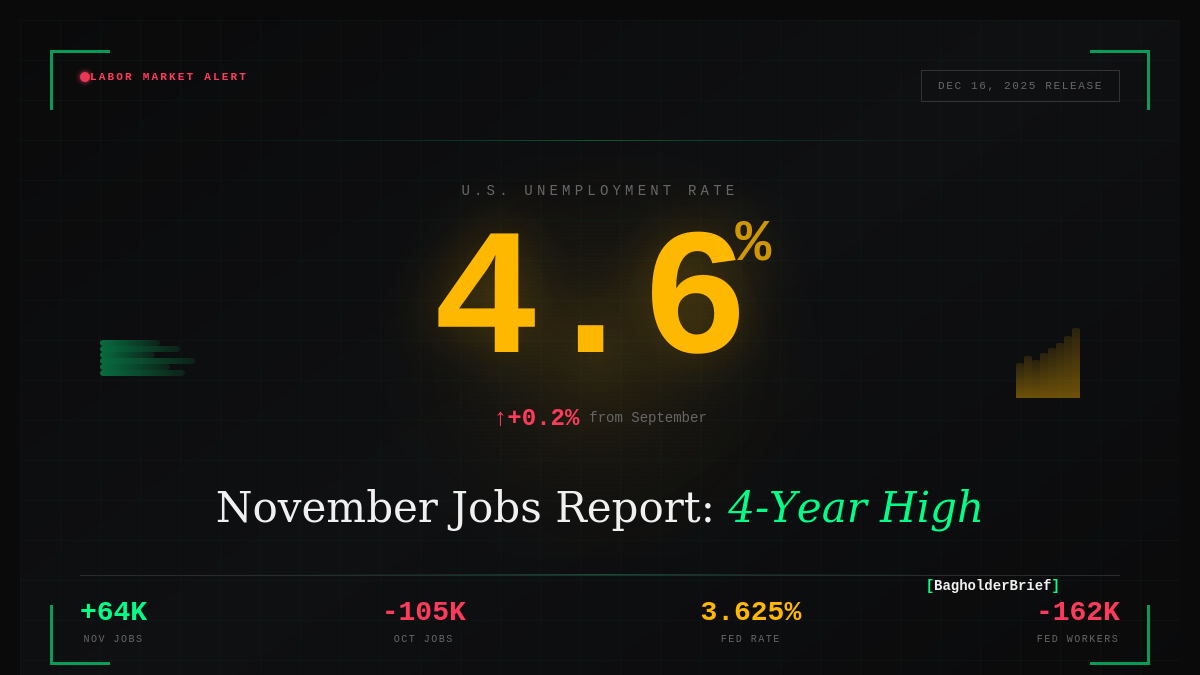
The Bureau of Labor Statistics delivered a sobering assessment of the American labor market today, releasing delayed employment data that paints a picture of an economy losing momentum at a pace that has caught even Fed officials off guard.[1] The unemployment rate surged to 4.6% in November—the highest level since September 2021—while the economy added a mere 64,000 jobs, well below the pace needed to absorb new entrants to the workforce.
For investors and policymakers alike, these numbers represent more than statistical noise. They signal a fundamental shift in the labor market’s character, one that transforms the calculus for everything from Fed policy to sector allocation. The Employment Situation November 2025, released December 16, 2025, reveals that the U.S. may already be experiencing what Moody’s chief economist Mark Zandi has termed a “jobs recession.”[2]
The economy has added just 100,000 jobs over the past six months—and without healthcare’s contributions, that figure would be deeply negative. This is the narrowest sectoral concentration of job growth since the Great Recession.
What the November 2025 Jobs Report Said (Released Dec 16, 2025)
Today’s release was unique in modern economic history. Historically unprecedented in the modern monthly series: the unemployment rate has been published continuously since 1948, but the government shutdown prevented household survey data collection for October.[3] November’s data carries a higher-than-usual margin of error as a result, but the directional signal is unmistakable: the labor market is cooling faster than consensus expected.
The jump from 4.4% in September to 4.6% in November represents a meaningful acceleration in the deterioration trajectory. More concerning is the context: the economy has now experienced outright job losses in three of the past six months (June, August, and October), a pattern that historically presages broader economic contraction.
Why October 2025 Unemployment Data Is Missing
The October data, while lacking a household-derived unemployment rate, revealed a net loss of 105,000 jobs—driven almost entirely by the separation of 162,000 federal workers who had accepted the Trump administration’s deferred resignation program earlier in the year.[4] These separations, effective September 30, marked the largest single-month decline in government employment on record outside of wartime demobilization.
The jobs report delayed by government shutdown created unprecedented gaps in economic data. The 43-day federal government shutdown prevented BLS field representatives from conducting the household survey that generates the unemployment rate. This is why there is no October 2025 unemployment rate—a data gap that complicates analysis of labor market trends.
Source: BLS, December 16, 2025
| Month | Jobs Change | Unemployment | Notable Factor |
|---|---|---|---|
| September 2025 | +119,000 | 4.4% | Pre-shutdown baseline |
| October 2025 | -105,000 | N/A | Federal separations, shutdown |
| November 2025 | +64,000 | 4.6% | Partial recovery |
Where Job Growth Came From: Healthcare and Construction Carried the Print
Perhaps the most concerning aspect of the current labor market is its extraordinary concentration. Healthcare added 46,000 jobs November 2025, while construction added 28,000 jobs—with nonresidential specialty trade contractors accounting for 19,000 of those gains.[6] This category encompasses the electrical and mechanical work essential to AI facility buildout.
Healthcare and social assistance have accounted for nearly half of all job growth in 2025—a level of sectoral dependence that Navy Federal Credit Union chief economist Heather Long describes as indicative of a “jobs recession” regardless of headline figures.[5]
Source: Bureau of Labor Statistics, December 16, 2025
+46,000
+28,000
+18,000
-5,000
-12,000
-18,000
-24,000
“Since the beginning of the year, the economy has created a paltry 600,000 jobs, but without the job growth in healthcare and hospitality, there would be zero job growth.”
— Mark Zandi, Chief Economist, Moody’s Analytics
Federal Layoffs/Buyouts and the 162,000 Government Jobs Drop
Any analysis of 2025’s labor market must contend with the unprecedented intervention of the Department of Government Efficiency. Since January, the initiative has overseen the separation of nearly 200,000 federal workers through a combination of mass layoffs, voluntary buyouts, and the “Fork in the Road” deferred resignation program.[10]
The federal government jobs down 162,000 in October represents the largest single-month decline in government employment on record outside of wartime demobilization. The effects extend beyond headline employment figures. Federal workers typically have higher-than-average wages and spending propensity; their removal from payrolls creates second-order demand effects throughout the economy.
The concentration of federal employment in the Washington, D.C. metropolitan area—roughly 150,000 residents—has produced localized recession conditions, with some businesses reporting 50% revenue declines during the shutdown period.[11]
The Office of Personnel Management estimates the federal workforce will shrink by 300,000 employees—roughly one in eight civilian workers—by year-end 2025.[12] This represents a structural shift in government employment that will take years to fully manifest in economic data.
What This Means for the Fed After the Dec 10 Rate Cut (3.5%–3.75%)
The Federal Reserve delivered its third consecutive rate cut just last week, lowering the federal funds rate to 3.5% to 3.75% in December 2025.[7] The decision was unusually contentious: three of twelve voting members dissented, the highest level of disagreement in six years, with one member favoring a larger cut and two preferring no action at all.
Chair Powell acknowledged at last week’s press conference that the labor market is “under pressure” and faces “significant downside risks.”[8] Today’s data validates those concerns—and then some. The Fed’s September projections had unemployment peaking at 4.5%; we’ve already breached that level with the first reading.
The Fed now faces a classic stagflation-lite scenario: unemployment at 4.6% and rising, while core PCE inflation remains stuck at 2.8%—well above the 2% target. Rate cuts to support employment risk further entrenching inflation; holding rates steady could accelerate job losses.
January 2026 Fed Rate Cut Odds
Fidelity’s fixed income research team noted prior to today’s release that unemployment above 4.5% would put a January rate cut “back on the table.”[9] With November’s print exceeding that threshold, the January 2026 fed rate cut odds have shifted meaningfully. Fed funds futures now price in a roughly 65% probability of a 25 basis point cut at the January 29 meeting, up from 40% before today’s release.
The question now is whether policymakers—operating with a divided committee and a new Fed chair expected by mid-2026—have the conviction to cut into elevated inflation.
2026 Outlook: What Forecasters Expect vs Where We Are Now
Professional forecasters paint a cautiously pessimistic picture for the coming year. The Survey of Professional Forecasters projects unemployment 2026 averaging 4.5% before declining to 4.4% in 2027—figures that may prove optimistic given today’s 4.6% starting point.[13]
2026 Forecast
4.5-4.7%
↑ vs. current
2026 Forecast
~49K
↓ from 2024 avg
Next 12 Months
30-42%
↑ from Q3 2025
End 2026
3.0%
↓ 50-75 bps
The Indeed Hiring Lab crystallized the core uncertainty in a recent analysis: “The question won’t be whether the market thaws—it will be whether it cracks.”[14] The current “low-hire, low-fire” equilibrium cannot persist indefinitely. Either hiring must resume, or the dam of labor hoarding that has characterized post-pandemic employment will break, releasing a flood of layoffs that transforms weakness into outright contraction.
Key Variables to Monitor
Initial Jobless Claims: Weekly claims have remained subdued, suggesting employers are not yet moving to aggressive layoffs. A sustained move above 250,000 would signal regime change.
Healthcare Employment: With this sector accounting for nearly half of job creation, any slowdown—whether from Medicaid cuts, demographic shifts, or hiring fatigue—would remove the economy’s primary employment engine.
AI Infrastructure Spending: The $405 billion in projected 2025 AI investment has created an employment floor in construction and related trades. Any pullback in hyperscaler capex would have immediate labor market consequences.
Immigration Policy: The sharp reduction in net migration has lowered the economy’s break-even job creation threshold—fewer workers entering means fewer jobs needed to maintain stable unemployment. This cuts both ways: it masks weakness in headline figures while reducing the economy’s long-term growth potential.
What Does 4.6% Unemployment Mean for Stocks?
The labor market data released today reinforces our view that defensive positioning remains warranted heading into 2026. Healthcare equities, particularly those focused on services rather than pharmaceuticals, benefit from both demographic tailwinds and countercyclical employment characteristics. Financials face headwinds from compressed net interest margins as the Fed cuts, though credit quality concerns may be overstated if unemployment stabilizes near current levels.
Technology names with AI exposure deserve continued weighting, as infrastructure buildout provides insulation from broader employment weakness. However, investors should distinguish between AI beneficiaries (cloud infrastructure, semiconductors) and AI-displaced sectors (administrative services, basic software) where labor substitution represents a secular headwind.
Fixed income markets have repriced meaningfully in anticipation of Fed easing, but the term premium on longer-duration bonds remains inadequate compensation for inflation uncertainty. We favor short-to-intermediate duration Treasuries and investment-grade corporates with strong balance sheets.
November’s unemployment data confirms what anecdotal evidence has suggested for months: the American labor market is weaker than headline figures indicate. At 4.6%, we are not in recession territory—but we are uncomfortably close to it, with recession probabilities elevated and rising. Position portfolios for continued volatility and favor quality over momentum as the economy navigates this challenging transition.
Frequently Asked Questions
Is 4.6% unemployment high enough to signal recession?
Not on its own, but it’s a warning sign. Historically, when unemployment rises by 0.5 percentage points from its cycle low—a threshold known as the Sahm Rule—recession follows within months. We’re now 1.2 percentage points above the 3.4% low set in January 2023. The bigger concern is the trajectory: unemployment rising 0.2% in a single month suggests acceleration, and the narrow concentration of job growth in healthcare indicates underlying weakness. We’re not in recession yet, but the margin for error has shrunk considerably.
Why was the jobs report delayed in 2025?
The 43-day federal government shutdown, which began October 1 and ended November 12, prevented the Bureau of Labor Statistics from conducting its normal data collection operations. BLS field representatives couldn’t perform the household surveys that generate unemployment rate data. The establishment survey (which counts payrolls) was less affected because it relies on employer submissions rather than in-person interviews. This is why we have October payroll data (-105K jobs) but no October unemployment rate.
Why is there no October 2025 unemployment rate?
The unemployment rate comes from the Current Population Survey, a household survey that requires BLS field representatives to contact approximately 60,000 households each month. During the shutdown, these operations ceased entirely. Unlike payroll data—which comes from employer submissions—the household survey cannot be reconstructed retroactively. This marks a historically unprecedented gap in the modern monthly series; the unemployment rate has been published continuously since 1948.
Which sectors added the most jobs in November 2025?
Healthcare dominated with 46,000 new jobs, continuing its role as the economy’s primary employment engine in 2025. Construction added 28,000 jobs, with 19,000 coming from nonresidential specialty trade contractors—a category heavily influenced by data center and AI infrastructure buildout. Social assistance added 18,000. On the losing side, federal government employment fell by 24,000 (continuing the DOGE-driven workforce reduction), transportation and warehousing lost 18,000, and leisure/hospitality shed 12,000 jobs.
Will the Fed cut rates in January 2026?
Fed funds futures currently price in roughly 65% probability of a 25 basis point cut at the January 29, 2026 FOMC meeting, up from 40% before today’s jobs report. However, the decision isn’t straightforward. Core PCE inflation remains at 2.8%—well above the 2% target—creating tension between the Fed’s dual mandates. Fidelity’s fixed income team noted that unemployment above 4.5% would put January cuts “back on the table,” and we’ve now crossed that threshold. Watch for December inflation data and any significant deterioration in weekly jobless claims for signals on how the committee will lean.
References & Sources
- Bureau of Labor Statistics. “Employment Situation Summary – November 2025.” bls.gov, December 16, 2025.
- Zandi, Mark. Moody’s Analytics commentary, as quoted in CNN Business, December 16, 2025.
- Bureau of Labor Statistics. Technical Note: “Federal Government Shutdown” documentation, December 16, 2025.
- NPR. “The U.S. added just 64,000 jobs in November—a sign the labor market is slowing.” npr.org, December 16, 2025.
- Long, Heather. Navy Federal Credit Union commentary, as quoted in CNN Business, December 16, 2025.
- NBC News. “Already shaky job market weakened in October and November.” nbcnews.com, December 16, 2025.
- Federal Reserve. “Federal Reserve issues FOMC statement.” federalreserve.gov, December 10, 2025.
- Powell, Jerome. FOMC Press Conference Transcript, December 10, 2025.
- Fidelity Investments. “Fed meeting December 2025: Is the Fed done cutting rates?” fidelity.com, December 10, 2025.
- Partnership for Public Service. Federal workforce tracking data, August 26, 2025.
- CBS News. “Government shutdown impacts D.C. economy.” cbsnews.com, November 2025.
- NPR. “Federal agencies are rehiring workers and spending more after DOGE’s push to cut.” npr.org, October 1, 2025.
- Federal Reserve Bank of Philadelphia. “Fourth Quarter 2025 Survey of Professional Forecasters,” Q4 2025.
- Indeed Hiring Lab. Labor market analysis, November 2025.
Disclaimer: This article is for informational purposes only and does not constitute investment advice. Past performance is not indicative of future results. Always conduct your own research before making investment decisions. BagholderBrief is not a registered investment advisor.