Bloom Energy: The Hidden Infrastructure Play Powering the AI Revolution
Bloom Energy: The Hidden Infrastructure Play Powering the AI Revolution
While everyone’s chasing AI chip stocks, smart money is quietly positioning in the companies solving AI’s biggest bottleneck: power. Here’s why Bloom Energy might be the most misunderstood opportunity in the market.
NYSE: BE
Here’s a number that should stop you in your tracks: AI data centers will need 100+ gigawatts of new power by 2035. For context, that’s roughly equivalent to powering 75 million American homes. And here’s the problem—the grid can’t deliver it. Not even close.
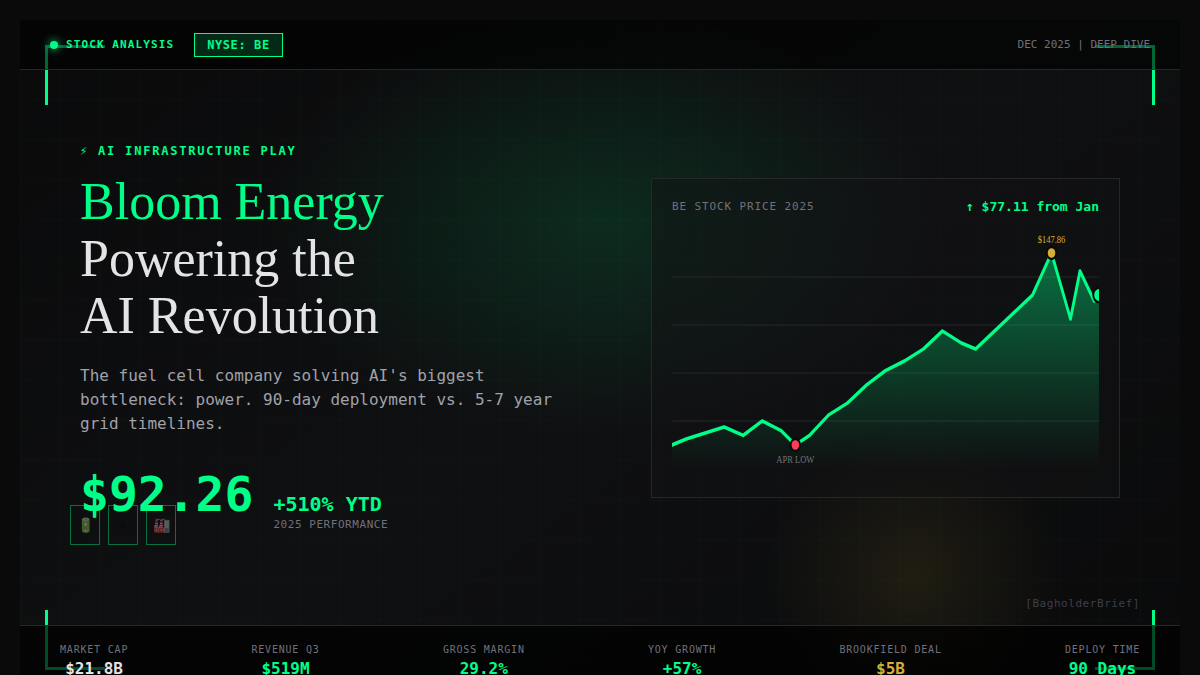
While the financial media obsesses over Nvidia’s next chip announcement, a quiet revolution is unfolding in an unsexy corner of the market: distributed power generation. And at the center of this transformation sits Bloom Energy, a company that’s gone from obscurity to a 500%+ gainer in 2025.
But is this a legitimate secular shift, or just another meme stock dressed up in clean energy clothing? After spending weeks digging through patents, earnings calls, and competitive dynamics, our research is out! Buckle up—this is going to be a thorough one.
The Setup: AI’s Inconvenient Power Problem
Let me paint you a picture. It’s 2025, and every major tech company is racing to build the largest AI data centers the world has ever seen. OpenAI and Nvidia just announced plans for 10 gigawatts of capacity. That’s equivalent to New York City’s peak summer demand—for AI compute alone.
Here’s where it gets interesting: traditional grid interconnection takes 5-7 years. Read that again. In an industry where 6 months feels like an eternity, hyperscalers are being told to wait half a decade for power.
⚡ THE GRID BOTTLENECK: Analysts estimate U.S. data centers face a power shortfall of roughly 45 GW through 2028. That’s not a technical challenge—it’s an existential crisis for AI buildout timelines.
Enter Bloom Energy with a proposition that’s almost too simple: What if you could deploy reliable, on-site power within 90 days?
That’s not marketing fluff. It’s what they’re delivering for Oracle right now. And it explains why Brookfield just committed $5 billion to deploy Bloom’s technology across what they’re calling “AI factories.”
What Makes Bloom Energy Different? The Technology Deep Dive
Let’s be honest, we were skeptical at first. Fuel cells have been “the future” for decades, burning through investor capital with little to show for it. Plug Power, FuelCell Energy, Ballard Power—the graveyard of broken promises is extensive.
But Bloom is fundamentally different, and it took us a while to understand why. Let’s break it down.
The NASA Origins Story
Bloom’s technology traces back to work CEO KR Sridhar did for NASA’s Mars program. The goal? Create a device that could produce oxygen and fuel on Mars using solar power. That technology—solid oxide electrochemistry—is the foundation of everything Bloom does today.
Here’s the elegant part: the same device that generates electricity from fuel can run in reverse to produce hydrogen from electricity. It’s like having a battery that never dies—as long as you feed it fuel, it keeps producing power.
The Proprietary Advantage: No Precious Metals
This is where Bloom separates from every other fuel cell company. While competitors like Plug Power require expensive platinum catalysts, Bloom’s cells use something almost absurdly simple: sand.
“Instead of precious metals, Bloom Energy’s fuel cells use wafers made from sand that are stained with proprietary ink. As fuel passes over the sand wafers, it mixes with oxygen, creating a chemical reaction that produces electricity.”
— The New York Times
Those “proprietary inks” are where the real IP lives. Bloom has filed over 1,000 patents globally, many focused on the specific electrode formulations that make their high-temperature chemistry work reliably.
How Bloom Stacks Up Against Competitors
Source: Company Filings, Industry Analysis
| Metric | Bloom Energy | Plug Power | FuelCell Energy | Gas Turbines |
|---|---|---|---|---|
| Electrical Efficiency | 60% | 40-50% | 45-47% | ~60% |
| Fuel Flexibility | NG, H₂, Biogas | H₂ Only | NG, Biogas | NG, Diesel |
| Precious Metals Required | None | Platinum | None | None |
| Gross Margin | 29.2% | -55% | Negative | 30%+ |
| Deployment Speed | 90 Days | Months | Months | Years |
| Carbon Capture Ready | Pure CO₂ Stream | N/A | Diluted | No |
The Efficiency Edge
In August 2024, Bloom achieved a milestone that matters: 60% electrical efficiency using 100% hydrogen. For non-engineers, that’s exceptional. It means less fuel in, more electricity out—which directly translates to economics.
But here’s where it gets really interesting. Bloom’s high-temperature operation (around 800°C) produces waste heat that can be captured for additional purposes: heating buildings, running industrial processes, or powering absorption chillers. When you factor in this combined heat and power capability, total efficiency reaches 90%.
Source: Industry Analysis
60%
60%
55%
45%
40%
35%
The Financial Picture: Finally Profitable
Let’s talk numbers, because this is where the story gets compelling.
Q3 2025 was a watershed moment. Revenue hit $519 million—up 57% year-over-year. That’s not just growth; that’s acceleration. The company posted four consecutive quarters of record revenue.
More importantly, margins are expanding. Gross margin reached 29.2%, up from 23.8% a year ago. Operating income flipped positive at $7.8 million, compared to a $9.7 million loss in Q3 2024.
The Partnership Momentum
The strategic partnerships Bloom has locked in during 2025 represent a step-change in commercial validation:
Brookfield commits up to $5B to deploy Bloom technology in “AI factories” globally. Marks Brookfield’s first investment in its dedicated AI Infrastructure strategy.
Bloom to deliver on-site power to Oracle AI data centers within 90 days—first direct hyperscaler contract.
American Electric Power contracts for up to 1 GW of Bloom fuel cells—one of the largest utility orders in fuel cell history.
100+ MW deployed across 19 IBX data centers in six U.S. states, with continued expansion.
The Multi-Platform Strategy: More Than Fuel Cells
Here’s what most investors miss: Bloom isn’t just a fuel cell company. They’ve built a platform that spans multiple high-growth markets.
Power Generation (Bloom Energy Server)
Core business: on-site electricity generation for data centers, manufacturing, and commercial buildings.
Hydrogen Production (Bloom Electrolyzer)
World’s most efficient solid oxide electrolyzer—produces 20-25% more hydrogen per MW than competitors.
Carbon Capture Integration
Unique architecture produces pure CO₂ stream, enabling efficient carbon capture and utilization.
Marine Applications
Partnerships with Samsung Heavy Industries and GTT to decarbonize shipping—a $2T+ addressable market.
The Investment Case: Bull vs. Bear
🐂 The Bull Case
- ✓Occupies critical infrastructure position in AI buildout
- ✓Only fuel cell company with positive gross margins at scale
- ✓1,000+ patents create significant competitive moat
- ✓$5B Brookfield deal validates technology at hyperscale
- ✓90-day deployment vs. 5-7 year grid timelines
- ✓Fuel flexibility future-proofs against hydrogen transition
- ✓Multiple revenue streams (power, hydrogen, carbon capture, marine)
🐻 The Bear Case
- ✗Extreme valuation: ~125x forward P/E, 230x+ EV/EBITDA
- ✗Stock up 500%+ in 2025—priced for perfection
- ✗Competition from GE Vernova and traditional turbine makers
- ✗Insider selling: executives have been trimming positions
- ✗Execution risk on manufacturing scale-up to 2 GW
- ✗Scandium supply chain concentration
- ✗Policy risk if clean energy incentives change
Valuation Reality Check
Let me be direct: Bloom’s valuation is stretched. A trailing P/E over 2,000x and forward P/E around 125x is not cheap by any traditional measure.
Bank of America, despite raising their price target, maintains an Underperform rating with a $39 target—implying 60% downside. That’s a stark reminder that even believers see valuation risk.
Upcoming Catalysts to Watch
Source: Company Calendar, SEC Filings
| Catalyst | Expected Timing | Potential Impact |
|---|---|---|
| Q4 2025 Earnings | Feb 5, 2026 | High FY25 guidance validation |
| European AI Factory Announcement | By EOY 2025 | High Brookfield partnership milestone |
| 2 GW Manufacturing Capacity | End 2026 | Very High Revenue scaling potential |
| Additional Hyperscaler Contracts | 2026 | High Customer diversification |
| FERC/PJM Data Center Power Rules | Q1 2026 | Medium Regulatory clarity |
The Bottom Line: Our Take
After weeks of research, here’s where we land: Bloom Energy is a genuinely differentiated company sitting at the intersection of AI infrastructure and the energy transition. The technology moat is real, the partnerships are validating, and the secular tailwind is powerful.
But—and this is a big but—the stock has priced in a lot of good news. At current levels, you’re betting on near-flawless execution over multiple years.
What We’d Do With Real Money
If you already own it: Congratulations on a monster 2025. Consider trimming 20-30% to lock in gains, but hold a core position. The long-term thesis remains intact.
If you’re looking to start a position: We’d wait. With a beta of 3.0, this stock will give you better entry points. A pullback to the $70-80 range would meaningfully improve the risk/reward. Set alerts and be patient.
If you want AI infrastructure exposure now: Consider a scaled approach—small starter position with a plan to add on pullbacks. This isn’t a “back up the truck” moment, but it’s also not a stock to ignore.
Key Monitoring Points
- Backlog conversion and deployment cadence—are contracts turning into recognized revenue?
- Gross margin sustainability above 28%—critical for the profitability thesis
- Manufacturing capacity ramp—can they hit 2 GW by end of 2026?
- Competitive announcements from GE Vernova and other traditional power players
- AI infrastructure spending trajectory—any slowdown impacts the narrative
💡 FINAL THOUGHT: In a market obsessed with AI chips, the smartest investors are looking one step removed—at the infrastructure that makes AI possible. Bloom Energy isn’t a speculative bet on the hydrogen future anymore. It’s a scaled business with real customers, real revenue, and a real moat. The question isn’t whether Bloom is a good company; it’s whether today’s price adequately discounts the risks ahead.
Frequently Asked Questions
What does Bloom Energy actually do?
Bloom Energy manufactures solid oxide fuel cells that convert natural gas, hydrogen, or biogas into electricity through an electrochemical process—without combustion. Their primary product, the Bloom Energy Server, provides distributed on-site power generation for data centers, manufacturing facilities, and commercial buildings. They also make electrolyzers for hydrogen production.
Why is Bloom Energy stock up 500% in 2025?
The stock surge reflects three major factors: (1) AI data centers’ desperate need for power that can be deployed faster than traditional grid connections, (2) validation through major partnerships including a $5 billion deal with Brookfield and contracts with Oracle and AEP, and (3) improving financials with four consecutive quarters of record revenue and positive operating income.
How does Bloom Energy compare to Plug Power?
The key differences are technology and economics. Bloom uses solid oxide fuel cells that don’t require platinum (Plug Power’s PEM cells do), can run on multiple fuel types (Plug is hydrogen-only), and achieve 60% electrical efficiency vs. Plug’s 40-50%. Most importantly, Bloom has 29%+ gross margins while Plug’s are deeply negative (-55%).
Is Bloom Energy profitable?
Bloom reached operating profitability in Q3 2025, posting $7.8 million in operating income. They have positive gross margins of 29.2% and generated positive cash flow. However, they’re still early in the profitability journey—trailing P/E is over 2,000x because earnings are minimal relative to the stock price.
What is Bloom Energy’s target price?
Analyst targets vary wildly, reflecting uncertainty about valuation. The average target is around $108-113, but Bank of America maintains a $39 target (Underperform) while bullish analysts see $130+. The wide range reflects the stock’s extreme valuation metrics and dependence on execution.
References & Sources
- Bloom Energy Corporation. “Third Quarter 2025 Financial Results.” investor.bloomenergy.com, October 28, 2025.
- Brookfield Asset Management. “Brookfield Partners with Bloom Energy on AI Infrastructure.” Press Release, October 2025.
- Oracle Corporation. “Oracle Selects Bloom Energy for Data Center Power.” oracle.com, July 2025.
- American Electric Power. “AEP and Bloom Energy Announce Framework Agreement.” Press Release, Late 2024.
- The New York Times. “Bloom Energy’s Fuel Cells Make Electricity, and Maybe History.” nytimes.com.
- SEC EDGAR. Bloom Energy Corporation Form 10-Q, Q3 2025.
- Bank of America Global Research. “Bloom Energy: Maintaining Underperform.” Analyst Note, December 2025.
- Seeking Alpha. “Bloom Energy: Powering AI.” seekingalpha.com, December 22, 2025.
- Yahoo Finance. “BE Stock Quote and Company Profile.” finance.yahoo.com.
- Company Filings, Bloomberg Terminal, Reuters, Industry Analysis.
⚠️ Disclaimer: This article is for informational and educational purposes only and does not constitute investment advice, a recommendation, or an offer to buy or sell securities. BagholderBrief and its contributors may hold positions in securities discussed. All investments involve risk, including loss of principal. Past performance does not guarantee future results. Please consult with a qualified financial advisor before making investment decisions. We lost money so you don’t have to—but that doesn’t mean we’re always right. Read our full disclaimer -> Legal