Yen Carry Trade Unwind: How BOJ Rate Hikes Are Draining Global Liquidity
Yen Carry Trade Unwind: How BOJ Rate Hikes Are Draining Global Liquidity
The Bank of Japan is about to hike rates to 0.75%—a 30-year high. Here’s why that seemingly small number is sending tremors through every asset class on the planet.
The Bottom Line:
→ The yen carry trade is the practice of borrowing cheap Japanese yen (at near-zero rates) and investing in higher-yielding assets abroad. It has served as a hidden engine behind global risk appetite for three decades.
→ The unwind happens when BOJ rate hikes make yen borrowing expensive or yen appreciation erases profits—forcing investors to sell foreign assets en masse to repay loans.
→ What gets hit first: Leveraged positions, tech stocks, emerging markets, and crypto feel the pain immediately. We saw exactly this playbook unfold in August 2024.
For most of recent financial history, the Bank of Japan served as the reliable dove among major central banks. Zero rates, perpetual easing, yen as the funding currency of choice—these were practically laws of nature in global macro. That framework is now being dismantled.
On December 18-19, 2025, the BOJ is widely expected to raise rates to 0.75%.[1] While three-quarters of a percent may seem trivial in isolation, this would represent Japan’s highest policy rate in thirty years. Not since the mid-1990s—before the Asian Financial Crisis, before the dot-com bubble, before quantitative easing became a household term—has Japan been at this level.
The yen carry trade, that multi-trillion-dollar funding mechanism that has quietly supported global risk assets, is now unwinding in earnest.
What Is the Yen Carry Trade (And Why Should You Care)?
The mechanics of the yen carry trade are straightforward, even if the scale is staggering.
For nearly three decades, Japan maintained interest rates at essentially zero—sometimes negative. Meanwhile, rates elsewhere ranged from 3% to 5% or higher. This created a simple arbitrage: borrow yen cheaply, convert to dollars (or Australian dollars, or emerging market currencies), invest in higher-yielding assets, and pocket the difference.
That difference is the “carry.” When the yen also depreciated against target currencies, profits compounded further.
The critical feature of this trade is its inherent leverage. Institutions don’t borrow billions of yen to earn 3% on Treasuries without amplifying returns. When conditions are favorable, the strategy generates consistent profits. When conditions reverse—when the yen suddenly strengthens or Japanese rates spike—exit pressure builds rapidly.
Estimating the trade’s size presents significant challenges. The Bank for International Settlements places the core carry trade at approximately ¥40 trillion ($250 billion) at minimum.[2] When accounting for off-balance-sheet derivatives, hedge fund leverage, and institutional flows, estimates range from $1 trillion to over $14 trillion in notional exposure.[3]
Some analysts have described it as “financial dark matter”—not directly observable, but its gravitational effects are pervasive.
The BOJ’s Historic Pivot: A Timeline
Understanding the current environment requires examining the last 20 months of BOJ policy decisions. The transformation from the world’s most accommodative central bank to one actively pursuing normalization has been remarkable.
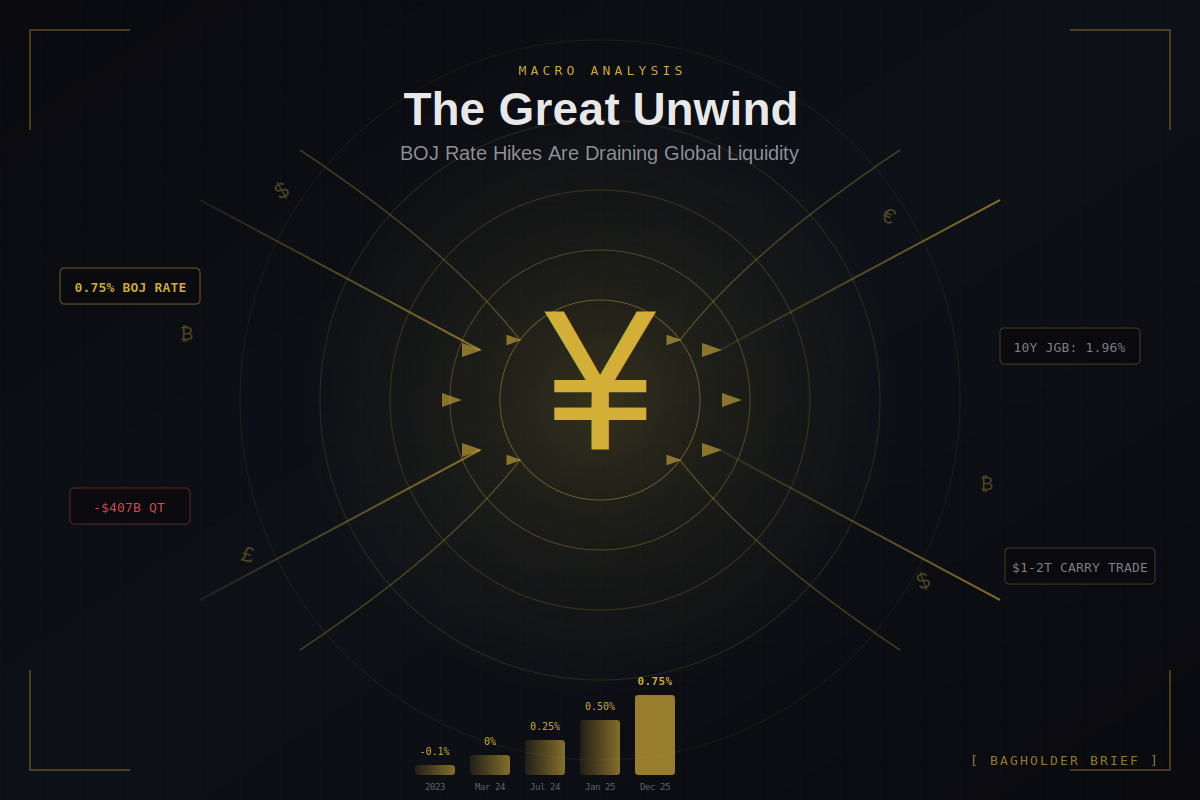
March 2024: Governor Kazuo Ueda ended negative rates for the first time in 17 years, moving from -0.1% to the 0%-0.1% range. The BOJ simultaneously abandoned yield curve control (YCC), the policy framework that had capped 10-year JGB yields around 0%.[4] Initial market reaction was muted—many viewed the move as overdue but insufficient.
July 2024: A second hike to 0.25%, combined with announced balance sheet reduction, caught markets off guard. The yen surged 14% in under a month. The consequences of this decision became apparent within days.
January 2025: Rates rose to 0.5%—the highest level since 2008. Governor Ueda cited emerging “virtuous cycles” between wages and prices as justification.[5]
December 2025: JGB 10-year yields have reached 1.96%, the highest since 2007.[6] Core inflation has persisted above the 2% target for over a year. The BOJ appears poised to move to 0.75%.
Negative (NIRP)
Normalizing
30-Year High
August 2024: A Case Study in Carry Trade Unwinding
The events of August 5, 2024, provide a clear demonstration of what yen carry trade unwinding looks like in practice. Market sentiment shifted from cautious concern to genuine alarm within hours.
The Nikkei 225 crashed 12.4%—its worst single session since Black Monday in 1987. The decline erased ¥113 trillion (approximately $790 billion) and wiped out all gains for the year.[2]
“The rapid move in the yen is putting downward pressure on Japanese equities, but it’s also driving an unwind of a major carry trade—investors had leveraged up by borrowing in yen to buy other assets, chiefly U.S. tech stocks.”
— BIS Bulletin No. 90
The trigger was a combination of the BOJ’s July rate hike and a weaker-than-expected U.S. jobs report that sparked recession concerns. Together, these catalysts ignited a cascade: yen shorts scrambled to cover positions, the currency surged, margin calls went out globally, and selling pressure compounded.
Bitcoin dropped from approximately $61,000 to around $54,000 within the span of the crisis.[7] The VIX spiked above 60—a level typically reserved for systemic crises. The S&P 500 fell 3% in a single session, its largest decline in nearly two years.
The recovery proved equally dramatic. Markets stabilized within days after BOJ Deputy Governor Uchida signaled the central bank would refrain from further hikes during periods of turmoil. However, the episode exposed the structural vulnerabilities inherent in globally distributed yen-funded positions.
⚠️ The August 2024 Lesson
What appeared to be a modest 25bp rate hike triggered a feedback loop that cascaded across every major asset class. The structural vulnerabilities were exposed—even if the immediate crisis passed quickly. Those vulnerabilities remain embedded in the financial system.
December 2025: Assessing Current Conditions
Several factors distinguish the current environment from August 2024. Whether these differences suggest a more orderly transition or merely a delayed reckoning remains to be seen.
The Rate Differential Is Compressing
A year ago, the spread between U.S. and Japanese rates exceeded 5%, making the carry trade extraordinarily profitable. Following the Federal Reserve’s rate-cutting cycle, with the fed funds rate now at 3.50-3.75%, the differential has narrowed considerably.[8] With the BOJ heading to 0.75%, the spread sits at approximately 2.75-3%. Still positive, but materially less attractive.
Japan
United States
Spread (Narrowing)
BOJ Quantitative Tightening Is Accelerating
Beyond rate hikes, the BOJ has been aggressively shrinking its balance sheet. In Q1 2025 alone, bond holdings fell by 6.2 trillion yen—the largest quarterly reduction on record. Since the early 2024 peak, total assets have declined by ¥61.2 trillion ($407 billion).[9]
For context, the BOJ at its peak held over 53% of all outstanding Japanese government bonds. The central bank essentially was the market. That dynamic is shifting, with significant implications for how Japanese rates behave going forward.
Speculator Positioning Has Shifted
Unlike mid-2024, when speculative positioning was heavily short the yen, current CFTC data shows net long positioning. This reduces snap-reaction risk—the most crowded portion of the trade has already partially unwound.
The Takaichi Factor
Japan’s new Prime Minister Sanae Takaichi took office in October 2025 as a vocal critic of BOJ tightening—she had previously characterized rate hikes as “stupid.”[10] As a disciple of Abenomics, the late Shinzo Abe’s playbook of aggressive fiscal stimulus and loose monetary policy, her instincts favor accommodation.
The political reality has proven more complicated. The weak yen (trading around 155 per dollar) is driving imported inflation that threatens her approval ratings. Japanese voters are expressing frustration with rising prices for food and energy. Reports indicate her cabinet will not oppose the December rate hike.[11]
💡 The Takaichi Paradox
PM Takaichi’s policy preferences—fiscal expansion and low rates—are classic Abenomics. However, the weak yen that accompanies those policies drives imported inflation, which erodes her political standing. She faces a choice between accepting BOJ tightening or watching consumer prices continue climbing.
How BOJ Tightening Affects Global Liquidity
The implications of the yen carry trade unwind extend well beyond Japan’s borders. For decades, cheap yen funding provided a persistent tailwind for risk assets globally—flowing into U.S. Treasuries, tech stocks, emerging market debt, real estate, and digital assets. When funding is essentially free, risk-taking flourishes.
That tailwind is now becoming a headwind.
JGB Yields Matter More Than Many Realize
With 10-year JGB yields at 1.96%, Japanese government bonds are offering their most attractive yields in nearly two decades. For Japanese institutional investors—pension funds, life insurers, asset managers—who have been chasing yield overseas for years, domestic options warrant renewed consideration.
State Street’s Masahiko Loo noted: “JGB sell-offs really matter for global bond markets.”[12] When Japanese yields rise, U.S. Treasury yields often follow. This correlation has strengthened throughout 2025.
The Crypto Connection
Evidence that yen carry trade dynamics affect even distant asset classes appeared on December 1, 2025. When JGB yields spiked to 1.84%, Bitcoin dropped from $92,000 to $83,832 within hours. The crypto market experienced over $640 million in liquidations.[13]
This correlation is not coincidental. Crypto, as one of the most liquidity-sensitive risk assets, functions as an early warning system for broader deleveraging. When yen-funded positions unwind, the effects appear in digital asset markets quickly.
U.S. Treasury Implications
Japan remains one of the largest holders of U.S. Treasuries. If rising domestic yields make JGBs more attractive relative to hedged Treasury holdings, capital allocation may shift accordingly. Japanese institutions reallocating toward domestic bonds would reduce demand for U.S. Treasuries at precisely the moment when federal deficits remain elevated.[14]
This does not constitute a crisis scenario, but it represents meaningful pressure on a market already navigating substantial supply.
What We’re Watching
Several indicators warrant close attention as this dynamic unfolds:
USD/JPY below 150: Rapid yen appreciation through this level has historically preceded broader risk-off episodes. The pair currently trades around 155.
BOJ communication: Governor Ueda’s tone following the December 19 decision will matter significantly. Hawkish guidance about 2026 could accelerate unwinding; dovish signals would calm markets. The post-meeting press conference represents the primary information event.
JGB auction demand: Recent 20-year JGB auctions have seen strong demand (bid-to-cover of 4.1, the strongest since 2020).[6] Sustained demand suggests orderly price discovery. Deteriorating auction metrics would signal more disorderly conditions ahead.
VIX behavior: Carry trade unwinds typically manifest in volatility before appearing in prices. VIX spikes above 25-30 without obvious catalysts often signal yen-related stress propagating through the system.
The era of near-zero yen funding is concluding. This does not necessarily imply 2008-style systemic risk—the transition, while volatile, may prove more orderly than bearish scenarios suggest. However, the tailwind that supported risk assets for three decades is no longer available.
Understanding how macro factors like central bank policy, yields, and currency dynamics affect risk assets is essential context for navigating this transition.
Key Takeaways:
→ The BOJ’s expected hike to 0.75% would be Japan’s highest rate in 30 years, signaling the end of ultra-loose monetary policy.
→ The yen carry trade has pumped an estimated $1-2 trillion into global risk assets—its unwinding drains liquidity from stocks, bonds, and crypto simultaneously.
→ August 2024’s 12.4% Nikkei crash demonstrated how quickly carry trade unwinding can cascade across asset classes.
→ The US-Japan rate differential has compressed to ~2.75-3%, materially reducing carry trade profitability.
→ Watch USD/JPY below 150, VIX spikes above 25, and JGB auction demand for early warning signals.
Frequently Asked Questions
What is the yen carry trade and why does it matter?
The yen carry trade is a strategy where investors borrow Japanese yen at near-zero interest rates, convert it to higher-yielding currencies like USD, and invest in assets paying 3-4% or more. It matters because this trade has channeled an estimated $1-2 trillion into global risk assets over decades, and its unwinding pulls liquidity out of stocks, bonds, and crypto simultaneously.
How does the yen carry trade affect US stocks?
When the carry trade is active, cheap yen funding flows into US equities, particularly tech stocks, providing steady buying support. When it unwinds (due to BOJ rate hikes or yen strengthening), investors must sell US stocks to repay yen loans, creating selling pressure. The August 2024 unwind saw the S&P 500 drop 3% in a single session.
What happens when carry trades unwind?
Carry trade unwinding creates a feedback loop: rising yen forces investors to sell foreign assets to repay yen loans, which pushes the yen higher, triggering more forced selling. This cascades across asset classes. In August 2024, the Nikkei crashed 12.4%, crypto markets dropped sharply, and the VIX spiked above 60.
Why does the BOJ rate hike to 0.75% matter for global markets?
The expected December 2025 hike to 0.75% would represent Japan’s highest rate in 30 years. It narrows the interest rate differential that made the carry trade profitable, raises yen borrowing costs, and signals the end of three decades of ultra-loose Japanese monetary policy that subsidized global risk-taking.
How does BOJ quantitative tightening affect global liquidity?
The BOJ has reduced its balance sheet by $407 billion since early 2024, curtailing bond purchases and draining liquidity from the system. Combined with rate hikes, this removes the “cheap money” that flowed into global markets for decades, tightening financial conditions worldwide.
What assets benefit from yen strength?
Gold typically benefits as investors deleverage and seek safe havens. Long-duration government bonds often rally as capital flows to safety. Japanese domestic stocks focused on domestic consumption (rather than exports) may outperform. Cash and short-term instruments become relatively more attractive in risk-off environments.
Why do JGB yields matter for US Treasury yields?
Japan ranks among the largest holders of US Treasuries. When Japanese government bond yields rise to more attractive levels (10-year JGBs reached 1.96% in December 2025), Japanese institutions may reallocate capital domestically, reducing demand for Treasuries and contributing to higher US yields. This correlation has been evident throughout 2025.
How can investors hedge yen carry trade risk?
Consider reducing exposure to assets most sensitive to yen strength: leveraged tech positions, emerging market debt, and crypto. Increase allocation to gold, short-duration bonds, and cash. Monitor USD/JPY closely—rapid moves below 150 often precede broader risk-off episodes. Options on the VIX can provide tail-risk protection during acute stress periods.
References & Sources
- The Japan Times. “BOJ will raise policy interest rate at next meeting.” japantimes.co.jp, December 12, 2025.
- Bank for International Settlements. “BIS Bulletin No. 90: The market turbulence and carry trade unwind of August 2024.” bis.org
- DL News. “How big is the yen carry trade — and why it matters to crypto.” dlnews.com, August 2024.
- CNBC. “Bank of Japan ends the world’s only negative rates regime.” cnbc.com, March 19, 2024.
- CNBC. “Japan hikes rates to highest since 2008.” cnbc.com, January 24, 2025.
- Trading Economics. “Japan 10Y Government Bond Yield.” tradingeconomics.com, December 2025.
- CoinDesk. Market data, August 2024.
- Federal Reserve. FOMC Statement, December 2025.
- Wolf Street. “Bank of Japan Balance Sheet QT Accelerates.” wolfstreet.com, October 2025.
- CNBC. “Bank of Japan holds rates after Takaichi’s ascent to prime minister.” cnbc.com, October 30, 2025.
- The Japan Times. “Japan finance chief effectively accepts BOJ rate hike.” japantimes.co.jp, December 14, 2025.
- CNBC. “Bank of Japan faces policy dilemma as bond yields hit new highs.” cnbc.com, December 4, 2025.
- BeInCrypto. “Japan’s Bond Breakout Threatens Crypto Market.” beincrypto.com, December 2025.
- American Enterprise Institute. “Beware of the Unwinding Japanese Carry Trade.” aei.org, December 2025.
Disclaimer: This article is for informational purposes only and does not constitute investment advice. Past performance is not indicative of future results. Always conduct your own research before making investment decisions. BagholderBrief is not a registered investment advisor. Check our full policy -> Legal